
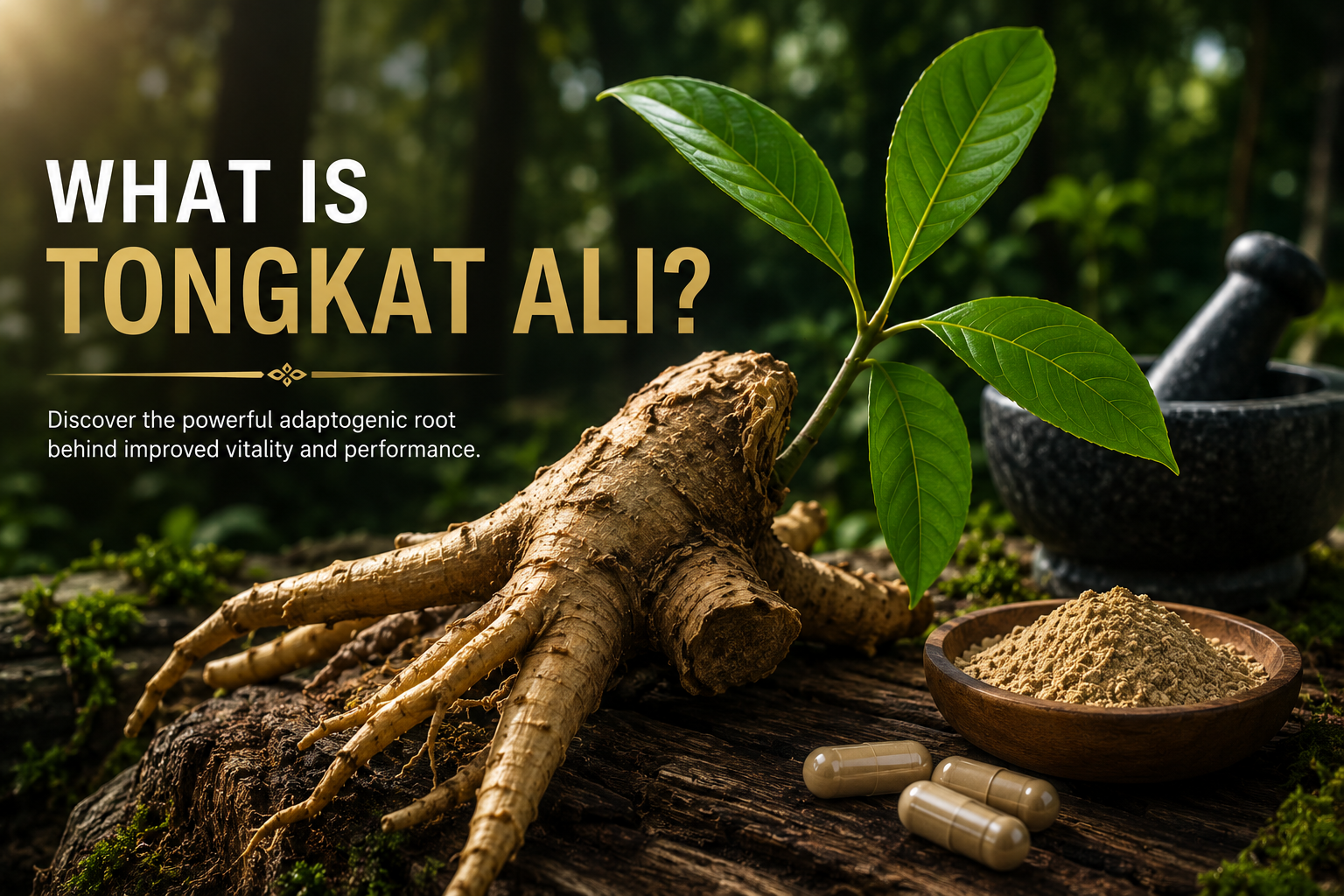
Tongkat Ali, also known by its botanical name Eurycoma longifolia, is a Southeast Asian plant whose root has a long history of traditional use and a growing body of modern human research. Today it appears in many men’s health and performance supplements, but the name on the label is only the beginning. Extract type, dose, study population, manufacturing quality and the rest of the formula all affect how useful a Tongkat Ali product may be.
What Is Tongkat Ali?
Tongkat Ali is a flowering, slender tree-like plant native to Southeast Asia, particularly Malaysia, Indonesia, Thailand and neighboring tropical regions, where it grows naturally in warm, humid forest environments. Its long root system is the part most commonly used in modern botanical preparations and supplements. You may also see it listed as Eurycoma longifolia, Longjack or Malaysian ginseng, although it is not actually a true ginseng.
Its modern popularity comes from the overlap between traditional use and scientific interest in areas such as testosterone status, stress, sexual well-being, fatigue and male performance. That does not mean every Tongkat Ali product has been clinically proven or that every user should expect the same result.
Traditional Use and Modern Interest
Tongkat Ali has been part of traditional botanical practices in Southeast Asia for generations. Historical use is relevant context, but Red Elephant does not treat traditional use as the same thing as clinical proof. Modern evidence has to be judged on the actual extract, dose, study design, population and outcome measured.
That distinction matters because research on one standardized extract cannot automatically be applied to every bottle that simply says “Tongkat Ali” on the label.
What Has Human Research Looked At?
Published human studies have examined Tongkat Ali in several areas, including testosterone measures in selected male populations, sexual well-being, stress-related outcomes, fatigue and physical-performance contexts. Some studies have reported favorable changes, while others are more limited or mixed.
The important point is not to turn those findings into a blanket promise. Study sizes are often modest, extracts differ, and results can depend heavily on the people being studied. For a closer look at the actual clinical literature, study design and limitations, continue to our Scientific Research page.
Dose Matters — But Milligrams Are Not the Whole Story
A 200 mg product is not automatically weaker than a 400 mg product, and a 400 mg product is not automatically better. Milligrams only tell you how much material is in the serving. They do not, by themselves, tell you the extraction method, concentration, standardization, active-constituent profile or quality of the raw material.
If you are comparing labels, use the dose as one piece of the picture rather than the whole decision. Our dedicated guide explains this in more detail: 200 mg vs 400 mg Tongkat Ali.
What Does a 100:1 or 200:1 Extract Ratio Mean?
Extraction ratios are often used in marketing, but they are easy to misunderstand. A ratio such as 100:1 or 200:1 generally describes a relationship between the starting botanical material and the resulting extract. It does not automatically tell you the amount of a specific active compound, and the larger number does not automatically mean the better product.
That is why extract ratio should be interpreted alongside dose, extraction method and product quality. See our full comparison: 100:1 vs 200:1 Tongkat Ali.
How to Judge Tongkat Ali Quality
- Botanical identity: the label should clearly identify Eurycoma longifolia and the plant part used.
- Serving amount: compare the actual amount per serving, not only the front-label headline.
- Extract information: concentration or extraction ratio can be useful, but should not be treated as a stand-alone quality score.
- Formula context: decide whether you want Tongkat Ali alone or a broader men’s performance formula.
- Seller and return protection: authenticity, transparent labeling and a clear return policy matter when buying online.
If your next question is which type of product actually makes sense to buy, continue to Which Tongkat Ali Supplement Should You Buy?
Tongkat Ali Alone or as Part of a Complete Formula?
A single-ingredient Tongkat Ali product can make sense if you want to isolate one botanical and control the rest of your supplement routine. A multi-ingredient formula may make more sense if your goal is broader male performance and you prefer one product that combines several complementary ingredients.
Neither approach is automatically superior. The better choice depends on your goal, the transparency of the label and whether the complete formula makes sense at the doses provided. We compare the two approaches directly in Tongkat Ali Alone vs an All-in-One Male Performance Formula.
Where Red Elephant Fits
Red Elephant Elite Formula includes 400 mg of Tongkat Ali root extract per two-tablet serving as part of a broader botanical-and-amino formula. Tongkat Ali is therefore a major ingredient in the formula, but Red Elephant is not presented as a finished-product clinical trial. The evidence belongs to the specific extracts, doses and populations studied in the published literature.
If you want to see how Tongkat Ali fits inside the full formula, continue to What Is Red Elephant?
Safety and Realistic Expectations
Tongkat Ali is a dietary-supplement ingredient, not a substitute for diagnosis or medical treatment. Individual responses vary, and people taking prescription medication, managing a medical condition or dealing with persistent sexual-health symptoms should speak with a qualified healthcare professional before starting a new supplement.
It is also worth remembering that symptoms involving libido, erectile function, fatigue or hormone concerns can have many possible causes. A supplement should not be used to delay appropriate medical evaluation.
Where Should You Go Next?
If you want the evidence first, review the human research. If you already understand the ingredient and are comparing products, move to the buying guide.